
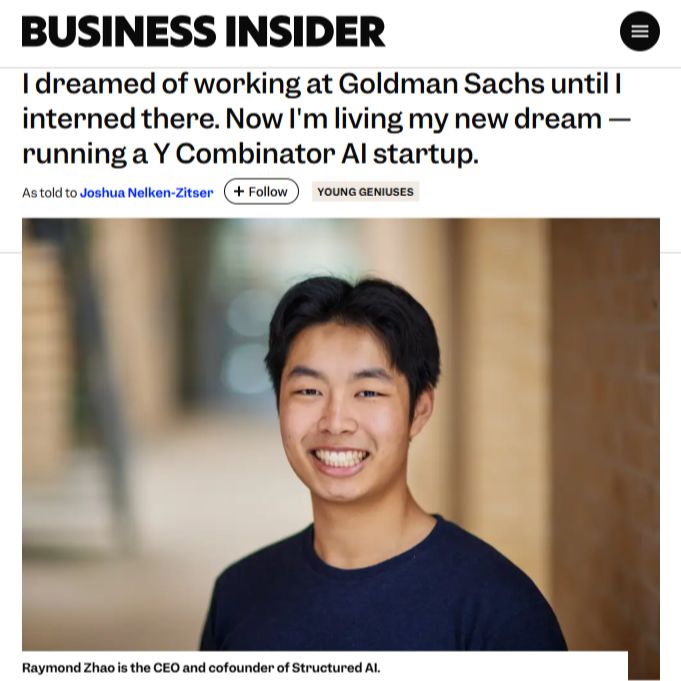
Business Insider covered Structured AI CEO Raymond Zhao's journey from a quantitative finance career at Goldman Sachs to co-founding a Y Combinator-backed startup focused on AI for construction. The article explored a question that resonates across industries: when a generational technology shift arrives, what is the real risk — leaving a stable career to build something, or watching the opportunity pass? For the construction engineering sector, the answer is becoming clear. The industry's manual workflows are unsustainable, and the founders building solutions are coming from unexpected backgrounds.
Why Construction Design Engineering Needs New Solutions
The construction industry is responsible for delivering the schools, hospitals, and infrastructure that communities depend on. Yet the engineering teams who design these buildings spend over a third of their working hours on manual, repetitive workflows: engineering drawing QAQC, specification cross-referencing, drawing schedule synchronization, and construction document review. These tasks are essential to quality, but they do not require the engineering judgment that design professionals trained for.
The downstream cost of this inefficiency is construction rework. MEP drawing errors that escape manual review become field change orders. Specification mismatches generate RFIs that delay projects by weeks. Coordination conflicts between structural and mechanical systems discovered during construction cost multiples of what they would have cost to fix during design. The industry loses billions annually to errors that better engineering design QA processes could have prevented.
How the Industry Has Managed Quality Until Now
Construction drawing review has relied on experienced engineers reviewing drawings manually — checking annotations, verifying dimensions, cross-referencing specifications, and flagging errors one by one. Senior professionals carry decades of institutional knowledge that makes them effective reviewers, but this knowledge does not scale. When those professionals retire, it leaves with them.
Firms have tried to systematize quality through checklists, review templates, and quality management systems. These help, but they remain manual processes that depend on human attention and discipline. Under deadline pressure — which is constant in construction — the thoroughness of engineering drawing validation decreases. The most experienced engineers are also the busiest, creating a persistent gap between the quality assurance the project needs and what the team can deliver with manual tools.
How AI Changes the Economics of Design Quality
As Raymond Zhao told Business Insider, Structured AI's mission is to help construction design engineers deliver better schools, hospitals, and infrastructure, faster. The company automates the tedious workflows that slow projects, freeing engineers to focus on safety, quality, and creativity. Here is what that automation looks like in engineering practice:
Automated Design Review Across Disciplines
AI agents perform automated design review on full drawing sets, scanning for MEP drawing errors, code compliance issues, and specification mismatches. AI for structural engineering validates connection details and load paths. AI for MEP engineering checks equipment schedules, duct sizing, and system coordination. AI for civil engineering verifies site grading, drainage, and accessibility compliance. This automated plan review runs in minutes across hundreds of sheets — work that takes human reviewers days.
Design Coordination That Scales
Design coordination AI identifies conflicts between disciplines automatically — structural elements clashing with mechanical systems, electrical routing conflicting with plumbing layouts, architectural details misaligned with structural framing. Engineering drawing validation across disciplines happens simultaneously rather than sequentially, catching the coordination errors that generate the most expensive construction rework. Teams that have met with Structured AI describe the impact as transformative: hours of manual effort replaced by systematic checks that surface issues for human judgment.
200 Engineers, 12 Cities, and a Clear Pattern
Business Insider highlighted a striking detail from Zhao's account: the Structured AI team has met with over 200 engineers across 12 cities, sitting beside them in their offices and observing their daily workflows. This hands-on research revealed a consistent pattern — engineers across every discipline and firm size spend their days on the same manual tasks. Formatting specifications, syncing schedules, completing QA/QC checklists, and performing construction drawing review consume the hours that should go toward designing and solving problems.
The Structured AI team watched their tools cut hours of manual effort from these workflows — giving engineers time back to do the creative, analytical work that drew them to the profession. For engineering firms evaluating AI for construction, this ground-level validation matters more than theoretical capabilities. The tools work because they were built by observing real engineering workflows, not by guessing at them from a distance.
Conclusion
Business Insider's coverage of Raymond Zhao's journey from Goldman Sachs to Structured AI captures a broader shift. The most ambitious technologists of this generation are turning their attention to industries like construction — sectors where manual workflows persist not because the problems are unsolvable, but because no one has built the right tools yet.
Automated design review, engineering drawing QAQC, and construction document review powered by AI are giving engineering teams the capacity to match the quality their projects demand. The engineers who design our schools, hospitals, and infrastructure deserve tools that free them from repetitive work — so they can focus on the design and problem-solving that shapes our built world. That is the compounding impact Structured AI was built to deliver, and it is the opportunity that made leaving Goldman Sachs the obvious choice.
Want to see how AI can transform your engineering workflows?
Book a Demo